How Hard Is Mission Viejo's Water? What 15 Grains Per Gallon Does to Your Plumbing
The district's own water quality report puts a number on it. Here is what that number means for your water heater, faucets and options.
Key Takeaways
- Santa Margarita Water District's 2026 report lists average hardness of 15 grains per gallon (256 ppm), with readings from 12.3 to 17.5.
- On the common USGS scale, anything above 180 mg/L counts as very hard, so Mission Viejo water sits in that top category.
- Hard water is an aesthetic and equipment issue, not a health issue, according to the district.
- Water heaters, tankless units, aerators and showerheads take the brunt of the scale.
What the District Report Actually Says
Santa Margarita Water District publishes a water quality report every year. The 2026 edition covers testing done during 2025 for Mission Viejo, Rancho Santa Margarita, Ladera Ranch, Coto de Caza, San Clemente and nearby communities. It lists total hardness at an average of 256 parts per million as calcium carbonate, with a range from 210 to 300.
The same table gives the figure in the unit most water softener labels use. Average hardness is 15 grains per gallon, and readings across the system ran from 12.3 to 17.5 grains per gallon. Total dissolved solids averaged 614 ppm, with a range from 510 to 680, and sodium averaged 95 ppm.
The report explains where the water comes from. Treated imported water arrives from the Metropolitan Water District, which blends Colorado River and State Water Project supplies, and from the Irvine Ranch Water District's Baker plant. The district's tables show Metropolitan's water at 14 grains per gallon and the Baker plant's at 17.
Where 15 Grains Per Gallon Falls on the Hardness Scale
The U.S. Geological Survey classifies water by milligrams per liter of calcium carbonate. The district's average sits well past the top threshold.
| Classification | Milligrams per liter | Grains per gallon (approx.) |
|---|---|---|
| Soft | 0 to 60 | Under 3.5 |
| Moderately hard | 61 to 120 | 3.5 to 7 |
| Hard | 121 to 180 | 7 to 10.5 |
| Very hard | Above 180 | Above 10.5 |
| Mission Viejo average (district report) | 256 | 15 |
What Very Hard Water Does Inside Your Home
Hardness minerals come out of solution when water is heated. That is why the water heater feels it first. Scale settles on the bottom of a tank, insulates the water from the burner or element, and makes a tank rumble as steam bubbles push through it. Over years it shortens the life of the heater. Our water heater replacement page covers when scale tips a repair into a replacement.
A tankless heater has less water volume and narrower passages, so scale builds up quickly in the heat exchanger. Most manufacturers call for a yearly flush in hard water, which our tankless service page describes.
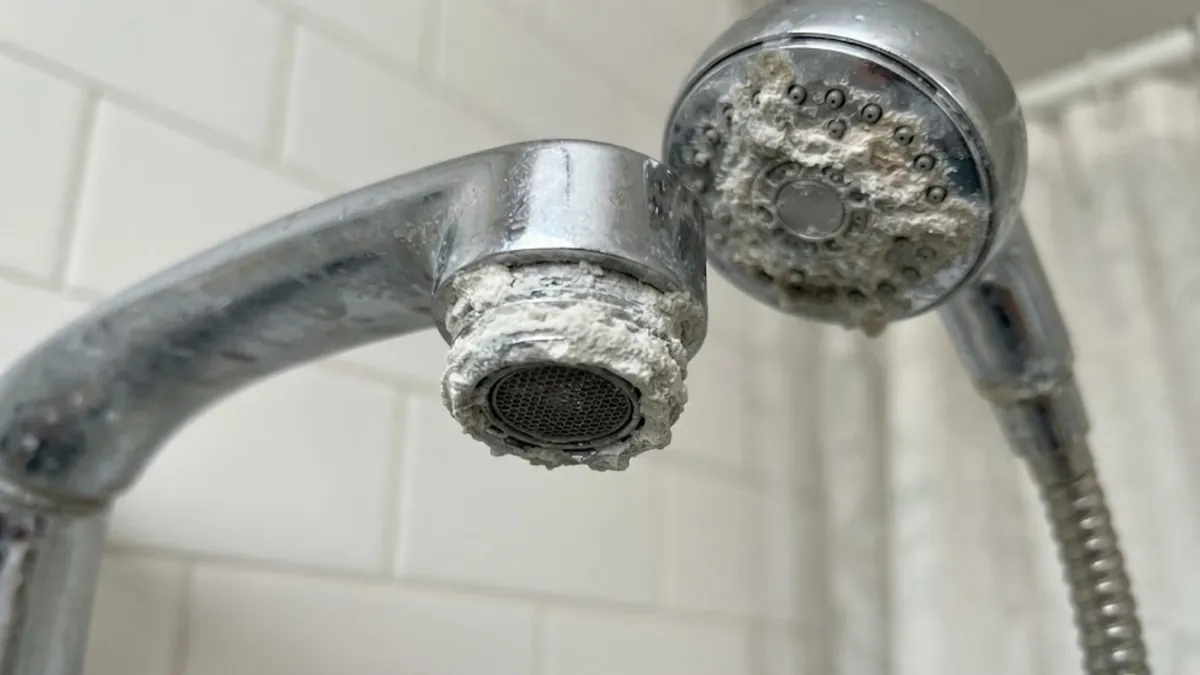
Fixtures show the damage you can see. White crust on faucets and showerheads, clogged aerators and spots on glass are scale. Dishwashers and washing machines also collect it internally. The district's own report suggests cleaning scaled fixtures with vinegar or using water softening to cut calcium carbonate in the hot water system.
What Hard Water Does Not Do
The district states that total dissolved solids are not associated with health effects, and that its water meets or surpasses federal and state drinking water standards. Hard water is a nuisance for equipment, skin feel and cleaning, not a safety problem in itself.
The district also tests tap water for lead and copper at residential taps every three years. In the most recent round, 52 homes were sampled in 2024. Lead was not detected in any of them, and the 90th percentile for copper was 0.079 ppm against an action level of 1.3 ppm. Those results describe the water the district delivers. Pipes inside your own home are a separate question.
Ways to Deal With Hard Water, From Cheap to Permanent
| Option | What it does | What to know |
|---|---|---|
| Vinegar soak for aerators and showerheads | Dissolves light scale | Quick and cheap, but it treats symptoms only |
| Yearly tank flush | Removes sediment from a tank heater | Slows damage and noise, does not stop scale from forming |
| Yearly tankless descaling | Cleans the heat exchanger | Needs isolation valves, see tankless service |
| Salt-based water softener | Removes hardness minerals | Check local rules first, see water softener installation |
| Salt-free conditioner | Changes how scale forms | Does not remove hardness minerals, so the hardness number stays the same |
How to Find Your Own Hardness Number
- Look at your water bill to see which agency serves you. Santa Margarita, Moulton Niguel and El Toro Water Districts all serve parts of Mission Viejo.
- Find that agency's most recent water quality report on its website and look for the line labeled hardness, total, in grains per gallon.
- If your report lists parts per million, divide by 17.1 to get grains per gallon.
- For a quick check at home, a test strip kit gives a rough hardness reading in minutes.
Local Rules and When to Call a Plumber
Salt-based softeners add salt to wastewater, and California law lets local agencies restrict them, in part because of recycled water. Mission Viejo irrigates more than 500 acres of parks and slopes with reclaimed water, according to the City of Mission Viejo. Ask your district about any limits before you buy.
If scale has already clogged fixtures, shortened a water heater's life or left a tankless unit throwing error codes, a plumber can assess the damage and size a solution. The same crew works in nearby Rancho Santa Margarita, which draws on the same district water.
How to Flush a Tank Water Heater, Step by Step
- Turn off the power at the breaker, or set a gas heater's control to pilot or off, and let the tank cool for a few hours.
- Close the cold water supply valve above the heater.
- Attach a garden hose to the drain valve at the bottom of the tank and run it to a floor drain or the yard.
- Open a hot water tap in the house to let air in, then open the drain valve and let the tank empty.
- Briefly open the cold supply to stir up sediment, and repeat until the water runs clear.
- Close the drain, refill the tank with the hot tap open until water flows steadily, then restore power or gas.
Hard Water Questions
Santa Margarita Water District's 2026 report lists an average of 15 grains per gallon, with a range from 12.3 to 17.5. Moulton Niguel and El Toro serve parts of the city and publish their own figures.
Yes. The district says total dissolved solids have no health effects and that its water meets federal and state standards. Hardness mainly affects equipment, fixtures and cleaning.
No. A softener removes hardness minerals. Chloramine removal needs a carbon filter, which is a separate system.
Once a year is a common recommendation. Tank units flush sediment through the drain valve, and tankless units need a descaling flush through service valves.
Scale Building Up at Home?
Call the 24/7 Mission Viejo line to talk through a softener, a flush or a heater replacement.
☎ Call (949) 325-3122