How to Check Your Water Meter for a Leak in Mission Viejo
A rising water bill is often the first sign of a hidden leak. This test takes two hours, costs nothing and tells you where to look.
Key Takeaways
- Check your meter before and after two hours with no water use. If it changes, you very likely have a leak.
- The EPA says the average household wastes nearly 10,000 gallons a year to leaks, and 10 percent of homes lose 90 gallons a day or more.
- Closing the main shutoff at the house tells you whether the leak is inside the house or on the buried service line.
- Toilets cause most silent leaks, and a few drops of food coloring find them.
Why a Leak Hides Behind a High Bill
Leaks do not announce themselves. A pinhole in a copper line, a toilet flapper that no longer seals or a cracked irrigation valve can run for weeks while the only symptom is a higher bill. The EPA's WaterSense program estimates that the average household wastes nearly 10,000 gallons of water every year to leaks, and that about 10 percent of homes lose 90 gallons a day or more.
A faucet dripping once a second wastes more than 3,000 gallons a year. A showerhead leaking at 10 drips a minute wastes more than 500 gallons a year. Swapping an old, inefficient toilet for a WaterSense-labeled model can save 13,000 gallons a year or more, depending on which EPA estimate you use. Those numbers come from EPA guidance that water agencies repeat each spring.
Santa Margarita Water District's 2026 water quality report makes the same point, noting that a small irrigation leak can waste thousands of gallons per year. Outdoor use is about 60 percent of home water use, according to the report, so irrigation deserves a look too.
The Two-Hour Meter Test, Step by Step
- Turn off every faucet and appliance. Pause the dishwasher, washing machine, ice maker and irrigation timer, and make sure no one flushes a toilet.
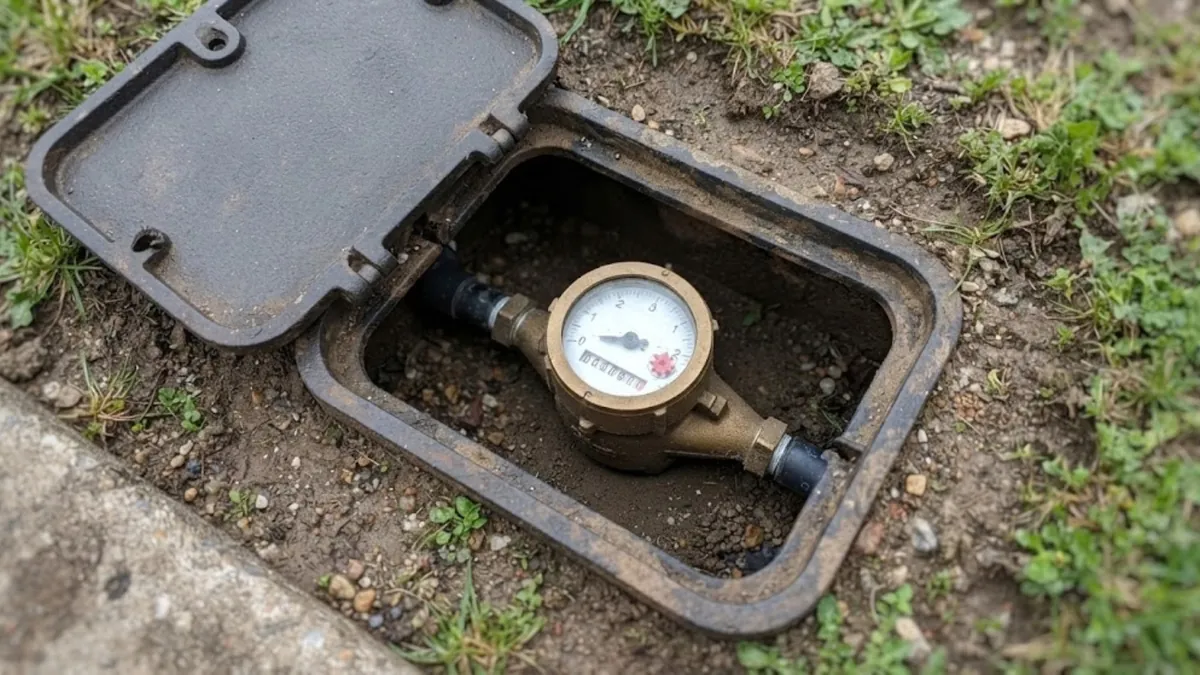
- Find your meter, usually in a ground-level box near the curb. Lift the lid carefully and look for the low-flow indicator, a small dial or triangle that spins when any water moves.
- Write down the reading, including the digits on the register. Take a photo of the dial too.
- Wait at least two hours without using any water, then read the meter again.
- If the number changed, or the low-flow indicator was spinning at the start, water is leaking somewhere.
What Each Result Tells You
| What you see | Likely meaning | Next step |
|---|---|---|
| Meter does not move in two hours | No steady leak, so the bill may reflect real use or a leak that only runs at certain times | Check bills against irrigation schedules and guests |
| Meter moves, stops when you close the house main | The leak is inside the house or on the pipe after the shutoff | Run the toilet dye test, then call for leak detection |
| Meter keeps moving after the house main is closed | The leak is on the buried service line between meter and house | See water line repair and replacement |
| Meter moves and a floor feels warm | A hot water line under a slab may be leaking | See slab leak detection |
The Toilet Dye Test
Toilets are the most common source of silent leaks, because the leak runs inside the bowl and makes no mess. Put a few drops of food coloring in the tank and wait about 10 minutes without flushing. If color shows up in the bowl, the flapper is leaking.
Water agencies and the EPA both recommend this test. A worn flapper costs little to replace, and the savings show up on the next bill. If the flapper keeps failing, the cause may be the flush valve itself, which is a job for toilet repair.
Units, Winter Use and What Looks Normal
Many California water bills use units of 748 gallons, which is one hundred cubic feet. Check your bill's unit before you compare months. Water agencies and the EPA also use winter use as a screening tool, since indoor use is steadier than summer irrigation. The EPA treats winter use above about 12,000 gallons a month for a family of four as a sign of a likely leak.
If your bill jumped and the meter test shows nothing, look at irrigation next. A stuck valve or broken head can run during the scheduled watering and stop afterward, so the meter test needs to run during or just after a cycle to catch it.
Your Water District, Then a Plumber
The agency named on your bill can verify the meter read and explain how its billing works. The three agencies serving Mission Viejo are Santa Margarita, Moulton Niguel and El Toro Water Districts. They own the meter and the main, and the line from the meter to your house is generally the homeowner's responsibility.
Once the meter test shows a leak on your side, a plumber finds it. The same 24/7 team serves nearby Laguna Niguel homes, where hillside pressure can add stress to older supply lines.
Irrigation Leaks: The Outdoor Half of Your Bill
Santa Margarita Water District's report says outdoor watering makes up about 60 percent of home water use. A broken head, a cracked valve or a pressure problem in an irrigation zone can run unseen at dawn or dusk and show up only as a larger bill.
To test, run each irrigation zone for a minute while watching the meter and looking at the heads. A zone that moves the meter far more than its siblings, or a patch of soggy ground, points to a leak. The report adds that adjusting sprinklers to avoid watering sidewalks and streets, and watering in early morning or late evening, reduces waste.
What to Tell the Plumber When You Call About a Leak
- The meter readings and times from your two-hour test, and whether the meter stopped when you closed the main.
- Whether the toilet dye test showed color in the bowl.
- Any warm spots on floors, damp walls, musty smells or the sound of running water.
- The age of the house and its pipe material, if you know it.
- Your last few water bills, since the jump in usage shows how long the leak may have run.
Water Meter Leak Questions
Open the meter box and look at the low-flow indicator, a small dial or triangle. If it moves when every fixture is off, water is flowing.
A small leak shows as higher usage over time. A meter test and a monthly look at your bill are the easiest ways to catch it.
The leak is inside the house or on the line after the shutoff. Run the toilet dye test, then have a plumber trace the supply lines.
Call the district to verify the meter read. If the read is correct and the meter moves with everything off, call a plumber to find the leak.
Meter Still Moving With Everything Off?
Call the 24/7 Mission Viejo line and a plumber can trace the leak.
☎ Call (949) 325-3122