Garbage Disposal Humming or Jammed? A Safe Step-by-Step Fix
A jammed disposal looks worse than it is. These steps free most jams in ten minutes without putting a hand near the blades.
Key Takeaways
- A disposal that hums but does not spin is usually jammed. A disposal that does nothing may need its reset button pressed.
- Always switch the unit off at the wall and never put a hand in the grinding chamber.
- Most units last about 8 to 15 years. A leak from the body means replacement, not repair.
- A new disposal has a knockout plug that must be removed or the dishwasher cannot drain.
Why a Disposal Hums and Stops
A garbage disposal grinds food scraps with a spinning plate that throws waste against a shredder ring. When something hard or fibrous wedges between the plate and the ring, the motor tries to turn, cannot and hums. After a few seconds an overload protector trips and the unit goes quiet.
The usual culprits are small bones, fruit pits, bottle caps, a utensil that slipped down the drain, or a wad of fibrous scraps such as celery strings, corn husks and artichoke leaves. Grease and starchy foods such as rice and pasta can also clump in the trap below and block the flow.
Both situations feel like a dead unit, and both are often fixable in minutes. The steps below follow the order a plumber uses, from the safest checks to the ones that call for a visit.
Safety First: Before You Touch Anything
- Switch the disposal off at the wall switch. If the unit plugs into an outlet under the sink, unplug it as well.
- Never put your hand into the grinding chamber, even with the power off. Use tongs or pliers to remove anything you can see.
- Do not pour chemical drain cleaner into a jammed or backing-up disposal. It sits in the trap and can splash on whoever opens the line.
- Use a flashlight to look into the unit instead of reaching in.
- If you smell burning or see sparks, leave the power off and call a plumber.
How to Free a Jammed Disposal, Step by Step
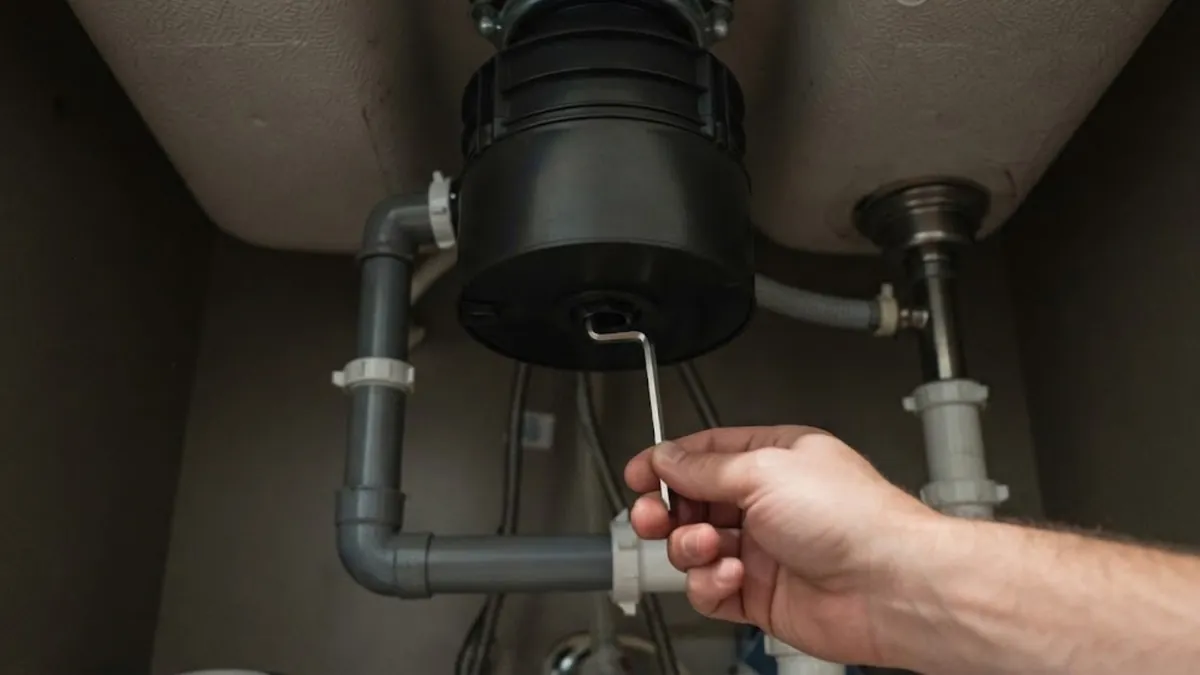
- Find the hex socket at the center of the bottom of the unit. Most disposals have a socket that takes a 1/4-inch Allen wrench, often supplied with the unit.
- Insert the wrench and turn it back and forth. Work it until the plate rotates a full turn in both directions.
- Remove any object you can see with tongs, then take the wrench out.
- Press the red reset button on the bottom of the unit once. It will click if it had tripped.
- Run cold water, switch the disposal on and check that it spins freely and drains without a gurgle.
What Each Symptom Means
| Symptom | Likely cause | What to do |
|---|---|---|
| Hums, does not spin | A jam on the plate | Turn it by hand with the hex key, then press reset |
| Completely silent | Tripped reset or no power | Press reset, then check the outlet, switch and breaker |
| Spins but sink drains slowly | A clog in the trap or line beyond the unit | Clear the trap, or see drain cleaning |
| Leaks from the top | A failed sink flange seal | Reseat or replace the flange seal |
| Leaks from the side or bottom | A cracked housing or worn internal seal | Replace the unit |
| Loud grinding or rattling | A foreign object or worn parts | Remove the object or plan a replacement |
The Detail That Surprises People After a Replacement
Most dishwashers drain through the disposal. A new disposal has a knockout plug inside the dishwasher inlet, a small disc of plastic that seals the opening until you remove it. If the plug stays in, the dishwasher cannot drain, and water pools at the bottom of the dishwasher after each cycle.
The plug comes out with a hammer and a screwdriver, and the loose disc has to be fished out of the unit. The dishwasher drain hose should also loop high or run through an air gap, as the California Plumbing Code, built on the Uniform Plumbing Code (UPC), calls for, so wastewater cannot flow back into the dishwasher.
What to Keep Out of a Disposal and How to Care for It
Keep grease, oil and fat out of the unit. They cool and harden in the trap and in the drain downstream, where a disposal cannot reach. In homes from the 1960s through the 1980s, grease-lined drain pipes are a common cause of kitchen backups, so the line suffers even when the disposal works.
Skip fibrous scraps, large bones, fruit pits, coffee grounds in quantity and non-food items. Run cold water before, during and for about 15 seconds after grinding, so scraps travel through the trap instead of settling in it.
Check your city's organics recycling program too. A disposal does not replace separating food waste where a program applies, and it is not a place for large amounts of scraps.
Repair, Replace or Call a Plumber
Replace a disposal that leaks from the body or the seals, runs loudly, jams over and over or is past about 10 to 15 years. Repair makes sense for a newer unit that has a single failed part, such as a jam or a loose connection. Our garbage disposal page explains what a replacement includes.
If water backs up into the other side of a double sink, the problem is the drain, not the disposal. The same 24/7 team clears kitchen lines and installs disposals in nearby Laguna Niguel.
A Monthly Routine That Keeps a Disposal Healthy
- Run cold water for 15 seconds before and after each use so scraps travel through the trap.
- Grind a handful of ice cubes now and then to knock film off the shredder ring.
- Feed scraps in small amounts instead of a heap, with the water running.
- Wipe the splash guard, the rubber baffle under the sink opening, since it traps odors.
- Listen for new noises. Rattling or grinding often means an object is stuck.
Choosing a Replacement Disposal
Horsepower is the first choice. A 1/3 or 1/2 horsepower unit suits light use, while 3/4 or 1 horsepower handles heavier use and grinds tougher scraps. A larger motor costs more and is usually quieter. Continuous-feed units run while the switch is on, and batch-feed units run only when a lid is turned, which some homes prefer.
Check the mounting. Many units are sized to fit the existing sink flange, but not all brands are interchangeable, and a mismatched mount takes longer to install. A dishwasher connection, an electrical switch and the trap alignment also affect the work. If the old unit leaks from its body, replace it instead of resealing it.
Garbage Disposal Questions
The grinding plate is jammed. Turn the power off, rotate the plate from the bottom with a hex key, and press reset.
Yes, with the power off. The hex socket on the bottom is designed for it. Never put a hand into the chamber.
Most last about 8 to 15 years, depending on use and what goes down them. Frequent jams and leaks are signs it is time to replace.
The knockout plug in the dishwasher inlet was probably left in. It has to be removed so the dishwasher can drain through the unit.
Disposal Still Dead or Leaking?
Call the 24/7 Mission Viejo line and describe the sound or the leak.
☎ Call (949) 325-3122