Copper Pinhole Leaks in Mission Viejo Homes: Causes, Signs and Your Options
Experts still argue about exactly why copper pipes pinhole. What is not in doubt is what to watch for and what to do about it.
Key Takeaways
- A pinhole leak is a tiny hole in a copper pipe, usually from corrosion that starts inside the pipe and eats outward.
- Researchers estimate about 750,000 pinhole leaks occur in the United States each year, and a 2021 review in AWWA Water Science says the causes are still poorly understood.
- Causes under study include water chemistry, velocity, pressure, installation issues and bacteria.
- A single leak is a repair, but repeated leaks in the same system point toward repiping.
What a Pinhole Leak Is and Why It Is Hard to Spot
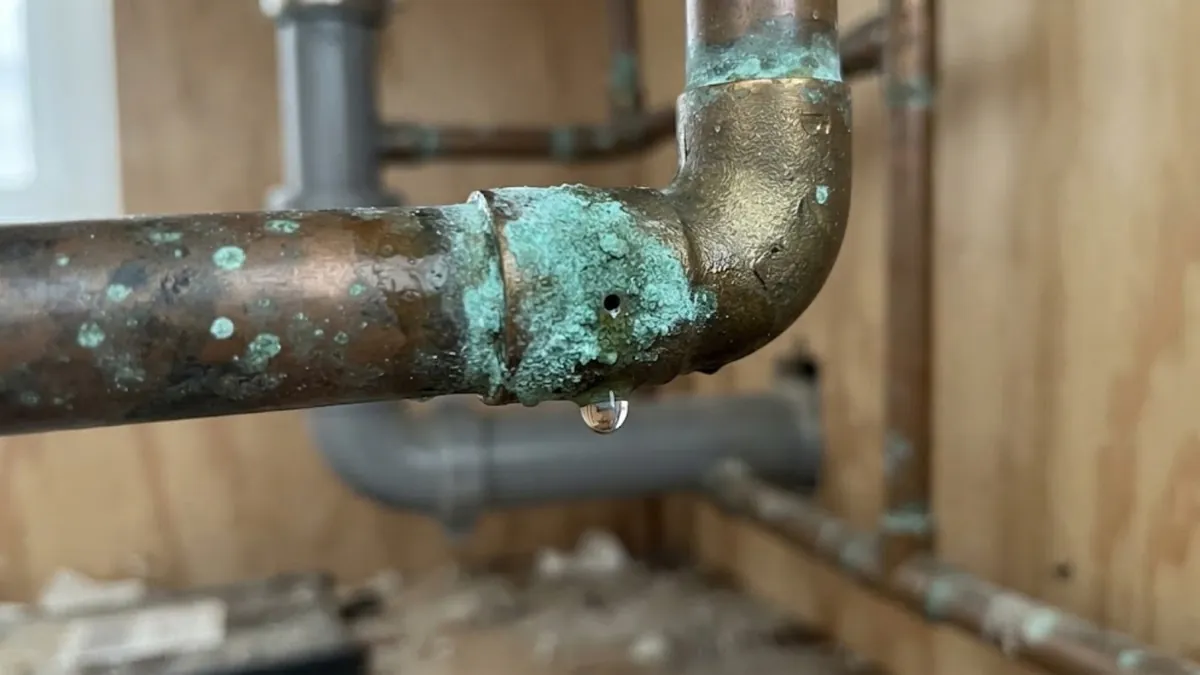
A pinhole leak is a hole in a copper pipe, small enough to resemble the point of a pin. Pitting corrosion usually starts on the inside surface of the pipe and works outward until the wall is breached. The leak is small, but under pressure it can spray a fine mist or a steady drip into a wall, ceiling or crawl space.
That makes them stealthy. A pinhole can run for weeks inside a wall before a stain appears or the water bill shows it. By then the drywall, insulation and framing may be damp and growing mold. This is why the early signs matter.
Mission Viejo's homes from the 1960s through the 1980s are in the age range where copper pipes have decades of service behind them. Casta del Sol's 1,927 homes were built between 1972 and 1987, and many other tracts share the same era.
Signs a Copper Line May Be Leaking
A hissing or dripping sound
Water spraying or dripping inside a wall or ceiling can be heard in a quiet house.
Damp spots and stains
Wet drywall, peeling paint, bubbling plaster or a stain on a ceiling below a bathroom.
Green or blue crust on copper
Mineral crust on a pipe or fitting shows corrosion on the outside surface.
A rising bill or a moving meter
The meter can keep turning with every fixture off, which a two-hour test will show.
What Experts Know and Do Not Know About the Cause
The honest answer is that no single cause explains every pinhole leak. A 2021 review of 30 years of research, published in AWWA Water Science, concluded that pitting corrosion of copper pipes is poorly understood. It estimated about 750,000 pinhole leaks a year in the United States and listed gaps, including the effect of water hammer and of changing disinfectant from chlorine to chloramine.
Researchers have linked pinholes to several factors: the pH and alkalinity of the water, the type and amount of disinfectant, high water velocity in undersized pipe, excess flux or poor workmanship at joints, and biological growth. Some California contractors have alleged that chloramine contributes. The science is not settled, and the water industry disputes it.
For a homeowner, this means a pinhole is rarely one thing. Age, water chemistry and pressure all play a part, and you cannot prove which one dominates in your house. What you can do is check the factors you control, starting with pressure.
Factors You Can Control or Test
| Factor | Why it matters | What to do |
|---|---|---|
| Water pressure | High pressure raises velocity and stress, and the Uniform Plumbing Code (UPC) calls for a regulator above 80 psi | Have a plumber test it and replace a failed regulator |
| Water hammer | Pressure surges can stress thin pipe walls | Install arrestors where valves slam shut |
| Hot water temperature and age | Hot lines often fail first | Check the heater, flush it, and replace it when due |
| Pipe age and condition | Older copper has more wear | Inspect exposed pipe, and track every leak with a date |
| Water chemistry | pH, alkalinity and disinfectant affect corrosion | Read your district's report, which lists these values |
What the District's Report Says About Copper
Santa Margarita Water District tests lead and copper at residential taps every three years. In its 2024 round it sampled 52 homes. Lead was not detected, and the 90th percentile for copper was 0.079 ppm, far below the 1.3 ppm action level, according to the district's 2026 water quality report. The district's water pH averaged 7.59.
Those numbers describe the water the district delivers and say nothing certain about pinholes in your pipe. Copper detected at the tap and pinhole leaks are different questions. The report is still the place to find your water's pH, alkalinity and disinfectant, which are the values researchers study.
Repair, Replace or Repipe
A single pinhole in a pipe that is otherwise sound is a repair. The plumber replaces the damaged section. If a second leak appears within a year or two, or the pipe shows green crust at many joints, that is a signal the pipe is wearing out everywhere. A clamp or patch is only temporary.
At that point, compare the cost of repeated repairs and water damage with a repipe. Repiping replaces the supply system with PEX or new copper, and PEX does not corrode from the inside the way copper can. If you only suspect a leak, leak detection finds it before walls are opened.
Keep a log. Note each leak's date, location and the repair, and keep the failed pipe section. A record helps a plumber recommend repiping, and it helps with an insurance claim if damage follows. The same crew serves nearby Laguna Niguel.
Repair or Repipe: A Simple Decision Guide
| What you see | Likely answer | Why |
|---|---|---|
| One leak in a pipe that is otherwise sound | Repair the section | The failure looks isolated |
| Two leaks within a year or two | Plan for repiping | A pattern points to wear throughout the system |
| Green crust or pits at many fittings | Inspect and likely repipe | Corrosion is not limited to one spot |
| Leaks only on the hot side | Check the heater and hot lines first | Hot lines often fail earlier |
| Pipe newer than 15 years with a leak | Investigate pressure and installation | Early failure usually has a specific cause |
Questions to Ask a Plumber About Repair vs Repipe
- What do you see that suggests the whole system is failing, or only this section?
- Can you pressure test the lines and check my water pressure before we decide?
- What pipe would you use, and what does the price include for drywall and permit?
- How long will the water be off each day, and can I stay in the house?
- What happens to the rest of the system if I only fix this leak today?
Pinhole Leak Questions
No single cause is proven. Researchers link them to water chemistry, velocity, pressure, installation issues and bacteria, and the science is still developing.
Some contractors say so and some research flags it as a gap, but the question is not settled. Check your district's report for the disinfectant used.
It varies a lot with water chemistry and installation. Many systems last for decades, and pinholes tend to show up as a system ages.
Not necessarily. One leak in sound pipe is a repair. Repeated leaks or widespread corrosion point toward repiping.
Seeing Signs of Pinhole Leaks?
Call the 24/7 Mission Viejo line to talk through leak detection or a repipe.
☎ Call (949) 325-3122