Chloramine in Mission Viejo Tap Water: What It Means for Filters, Fish and Fixtures
Your district's water report names the disinfectant. Here is what it is, what it does and the few things it changes at home.
Key Takeaways
- Santa Margarita Water District's 2026 report says imported and locally produced water is treated with chloramines, a mix of chlorine and ammonia.
- Chloramine lasts longer in pipes, forms fewer disinfection byproducts and has little to no odor when used properly.
- Dialysis patients and anyone keeping fish or aquariums need to take extra steps, according to the district.
- Standard carbon filters handle chloramine poorly, so the filter media matters.
What Chloramine Is and Why Districts Use It
Chloramine is a disinfectant made by combining chlorine and ammonia. Water suppliers add it at the treatment plant so that a residual stays in the water as it travels through miles of pipe to your tap. Santa Margarita Water District's 2026 water quality report says its imported and locally produced drinking water is treated with chloramines.
The report lists the reasons. Compared with chlorine alone, chloramines last longer in the distribution system, produce fewer disinfection byproducts and have little to no odor when used properly. The Metropolitan Water District and the Irvine Ranch Water District, which supply the district's treated water, both use it.
Moulton Niguel and El Toro Water Districts also buy imported supply, but each publishes its own report. Check yours for the disinfectant before you assume it matches.
What the District Measured in 2025
| Measure | District average | Legal limit |
|---|---|---|
| Chlorine residual | 1.83 ppm | 4 ppm (maximum residual disinfectant level) |
| Total trihalomethanes | 32 ppb | 80 ppb |
| Haloacetic acids | 8 ppb | 60 ppb |
| Odor | 1 threshold odor number | 3 (secondary standard) |
Who Needs to Take Precautions
The district's report is direct about two groups. Kidney dialysis patients should consult their health-care provider about water treatment, because chloramine must be removed from dialysis water. Anyone who keeps fish ponds, tanks or aquariums needs to adjust treatment, since chloramines are toxic to fish and other aquatic life.
For an aquarium, the usual fix is a conditioner labeled to neutralize chloramine, not just chlorine, since the ammonia is part of the compound. A pet store can explain the right product, and the district's customer care line can answer questions about the water supply.
Why Chloramine Changes Which Filter You Buy
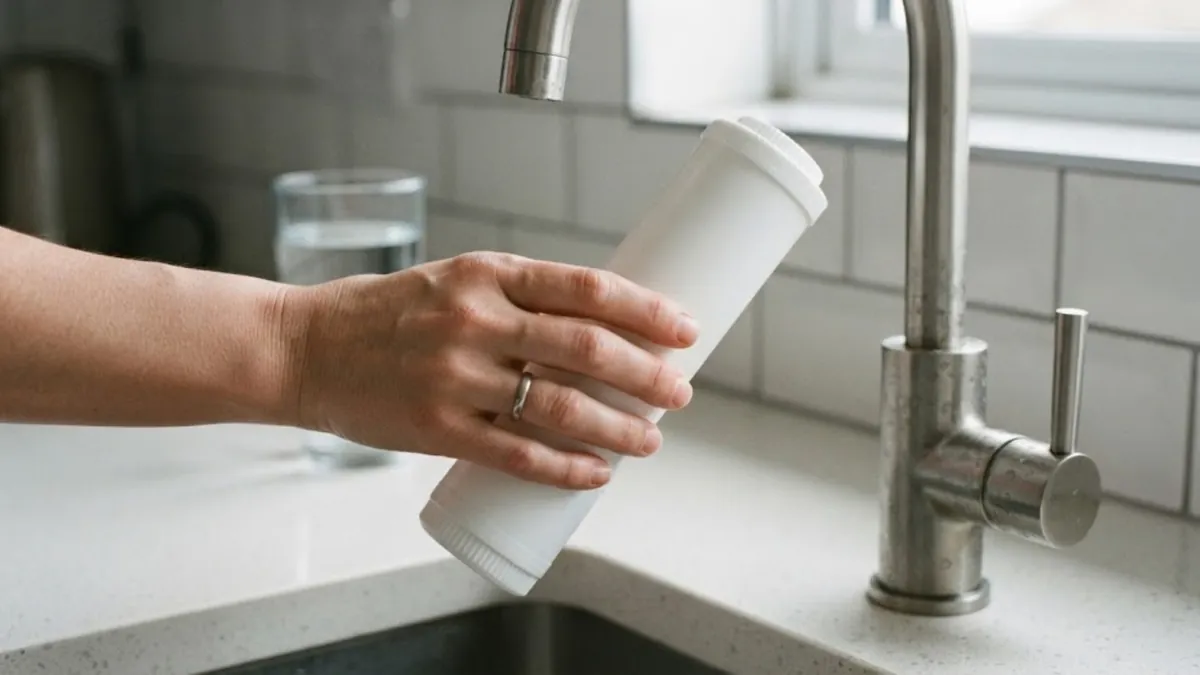
Chlorine is easy for an ordinary carbon filter to remove. Chloramine is more stubborn, and standard carbon removes it slowly or incompletely. Catalytic carbon is the usual match for whole-home chloramine reduction, and a reverse osmosis system also reduces it at the drinking tap.
That matters if you are shopping for a filter to improve taste or cut odor. Check that the product is certified for chloramine reduction, not just chlorine, to NSF/ANSI standards. Our water filtration page lists the options and the questions to ask.
Does Chloramine Affect Rubber Parts in Your Plumbing?
Water industry research has linked chloramine to faster aging of some rubber and elastomer parts than chlorine, such as toilet flappers, supply line gaskets and washers. The effect varies with the material and the water, and manufacturers have moved to chloramine-resistant materials.
If a toilet flapper hardens or turns slimy every couple of years, that is one possible reason. Replacing it with a chloramine-resistant flapper is a cheap fix. A toilet that keeps running after a new flapper points to a worn flush valve, which belongs under toilet repair.
What to Do With This Information
- Find your district's most recent water quality report and look for the words chlorine, chloramine or disinfectant.
- If you keep fish, buy a conditioner that states it neutralizes chloramine, and follow the label.
- If you use dialysis at home, ask your care team about water treatment for your supply.
- If you buy a filter, confirm it is certified for chloramine reduction.
- If toilet flappers fail often, use chloramine-resistant replacements.
Where This Applies
The statements above come from Santa Margarita Water District's report, which covers Mission Viejo, Rancho Santa Margarita, Ladera Ranch and nearby communities. Homeowners in Ladera Ranch get the same water, and the 24/7 team installs filters there.
None of this is a reason to worry. The district reports that its water meets or surpasses all federal and state drinking water standards. It is a reason to buy the right filter and to know why a fish tank or a rubber part behaves the way it does.
Common Myths About Chloramine at Home
Letting a glass of water sit out removes chlorine over time but does not remove chloramine, which is far more stable. That is a common reason people are surprised that a trick that works with chlorine does nothing here.
A kitchen pitcher is not automatically a chloramine filter. Many are rated for chlorine taste and odor only, and the label should say chloramine if it matters to you. Boiling is also not a reliable fix, as the FAQ below explains.
Chloramine is not the same as lead, and the district's report is a separate matter. Lead and copper are tested at residential taps every three years, and the district reported no lead detected in its latest round.
Reading Filter Labels Without Getting Fooled
- Look for NSF/ANSI certification marks, which show a product was tested against a published standard.
- Check which claims the certification covers. A mark for chlorine taste and odor is not the same as one for chloramine reduction.
- Look at the rated capacity in gallons and the change interval, then divide by your household use.
- Ask whether replacement cartridges are easy to find, since a filter is only as good as its last change.
How Closely the District Watches the Water
The district's report describes its testing program. Forty-three locations across the distribution system are tested monthly for color, odor and turbidity, and weekly for coliform bacteria. Eight locations are tested quarterly for disinfection byproducts. In 2025 the average chlorine residual was 1.83 ppm, well under the 4 ppm limit.
That monitoring is how the district checks that the disinfectant is doing its job without producing too many byproducts. It is also where a homeowner can see the numbers in plain tables, not just a statement that the water is safe.
What a Chloramine-Rated Filter Costs to Run, and What to Avoid
The price of a filter is only part of the cost. Replacement cartridges, the water pressure drop on a whole-home unit and the time to change media all add up, so ask for the yearly running cost before you buy. A plumber can quote the equipment and the installation, and you can compare that to the price of simply using a certified pitcher at the kitchen tap.
For safety, do not use a filter to treat water of unknown origin, and do not assume a carbon filter removes every contaminant. Avoid skipping cartridge changes, since a spent filter can release what it caught. If you are unsure, call your district's customer care line or a plumber before you decide.
Chloramine Questions
Public health agencies approve it as a drinking water disinfectant, and the district reports that its water meets all federal and state standards. People on dialysis and fish owners need extra steps.
Not effectively. Chloramine is stable, so boiling is not a reliable way to remove it. Use a filter certified for chloramine reduction or a fish-safe conditioner as needed.
Check the label. Many standard carbon filters are rated for chlorine only, and chloramine needs catalytic carbon or a filter certified for it.
Disinfectants leave a faint residual so the water stays safe in the pipes. A strong or unusual smell is worth reporting to your district.
Picking a Filter for Your Water?
Call the 24/7 Mission Viejo line to talk through a filter that matches your district's water.
☎ Call (949) 325-3122