California Water Heater Strapping and Permit Rules for Mission Viejo Homeowners
State law sets a clear baseline for how a water heater must be secured. Here is what it says and what a good replacement includes.
Key Takeaways
- Health and Safety Code section 19211 requires new, replacement and existing residential water heaters to be braced, anchored or strapped against earthquake motion.
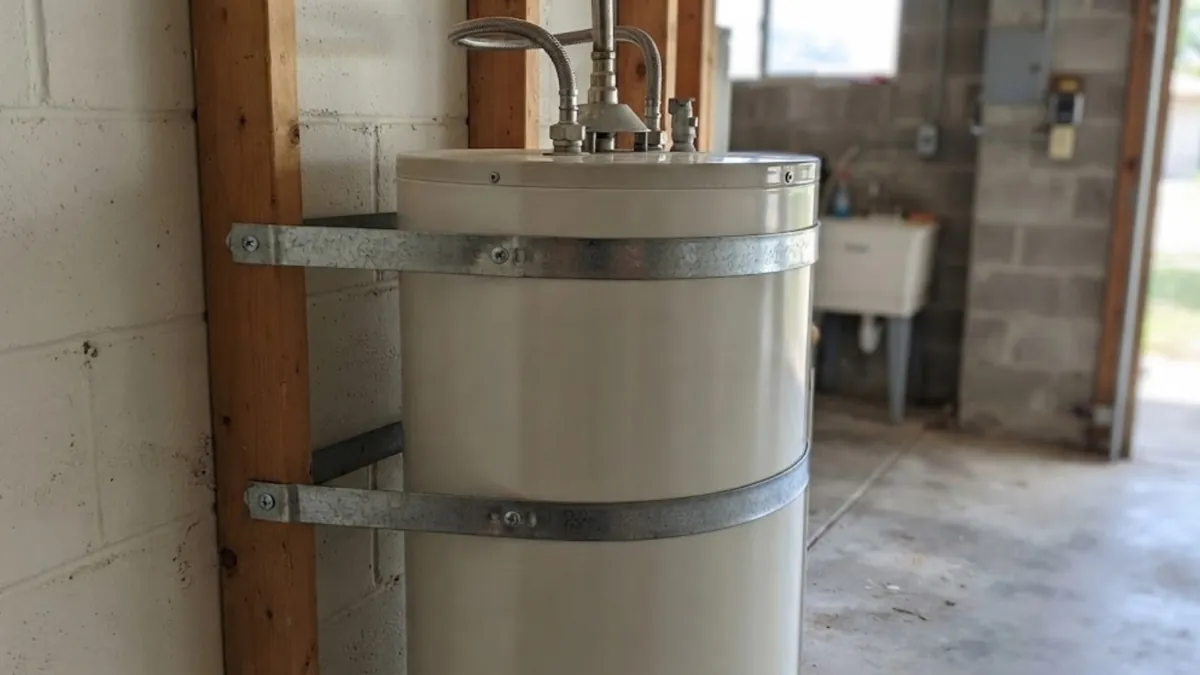
- At a minimum, the heater must be secured as the California Plumbing Code requires. That means at least two straps, one in the upper third and one in the lower third of the tank.
- A home seller must certify in writing to the buyer that the water heater meets the strapping requirement.
- A replacement normally needs a permit and inspection, so ask your plumber who pulls it.
What State Law Says About Water Heater Strapping
California law treats an unsecured water heater as a hazard. In an earthquake, a heater that falls can rupture gas and water lines and cause a fire or flood. Health and Safety Code section 19211 therefore applies to every new and replacement water heater and to every existing residential water heater, which must be braced, anchored or strapped to resist falling or horizontal displacement.
The statute sets a floor, not a ceiling. At a minimum, a heater has to be secured in accordance with the California Plumbing Code, which is built on the Uniform Plumbing Code (UPC), and a city or county can adopt local modifications. The law covers standard water heaters of up to 120 gallons for which a preengineered strapping kit is readily available.
The same law reaches home sales. A seller must certify in writing that the strapping requirement has been met, and the statement can appear in existing documents such as the Homeowner's Guide to Earthquake Safety, the purchase contract or the transfer disclosure statement.
A Replacement Checklist in Plain Terms
| Item | What the code asks | Why it matters |
|---|---|---|
| Strapping | At least two straps, one in the upper third and one in the lower third of the tank | Keeps the tank from toppling in an earthquake |
| Flexible connectors | Code-compliant flexible connectors on water and gas lines, where used | Lets lines flex instead of snapping when the tank moves |
| Garage elevation | A gas heater in a garage needs its ignition source raised off the floor, often on a platform | Prevents gasoline vapors near the floor from igniting |
| Expansion tank | Required where the water system has a check valve or backflow device | Absorbs thermal expansion that can raise pressure |
| Relief valve discharge | Piped to a safe termination point | Directs scalding water away from people |
Mission Viejo and the Earthquake Risk
Southern California sits among several active fault systems, and the rule exists because of damage seen in past quakes. State guidance notes that a properly strapped water heater is also a valuable source of potable water after a quake, since it holds dozens of gallons.
Many Mission Viejo homes put the heater in the garage. That placement adds the elevation rule for gas units and often means a platform. A heater in a closet or an attic has different clearance and access rules, so the install plan changes with the location. Our water heater replacement page walks through those differences.
How to Check If Your Heater Is Strapped
- Look for two metal straps wrapped around the tank, one near the top and one near the bottom, anchored into wall studs or masonry.
- Make sure the straps are snug. A loose strap does not stop movement.
- Check that the straps are fastened to studs and not just to drywall.
- Look at the gas and water connections. Rigid pipe on a tall tank is a warning sign.
- If a heater has an insulating blanket, move it aside to confirm the straps sit on the tank.
Permits, Inspections and Who Pulls Them
Water heater replacement normally needs a plumbing permit and an inspection, and the contractor should pull it. Confirm with the City of Mission Viejo's building division, since local rules can add steps. The inspector looks at strapping, venting, relief valve piping, gas connections and the expansion tank.
A replacement done without a permit can cause trouble at sale, with insurance claims after a failure, and when the next buyer's inspector looks at the garage. If a heater already fails inspection, water heater repair may still be possible, though the strapping must be fixed either way.
The same rules apply in nearby Laguna Hills and the rest of Orange County, with local variations.
Strapping When You Buy or Sell a Home
Because the seller must certify strapping in writing, a buyer can ask to see that statement and then check the heater in person. A walk-through takes a minute. Look for two straps, and confirm they are tight.
A seller who finds a loose or missing strap should fix it before listing. Pre-engineered strapping kits are widely sold, and the statute assumes one is readily available for standard heaters up to 120 gallons. If the heater is old or leaking, it is better to price a replacement than to strap a tank that is near the end of its life.
Safety Steps After an Earthquake: What to Do With Your Water Heater
- If you smell gas or hear it hissing, leave the house and shut off the gas at the meter if you can do so safely, then call 911 or SoCalGas at 800-427-2200 from outside.
- If the heater moved or the connections look damaged, close the cold water supply valve above it.
- Turn off the breaker for an electric heater before checking it.
- Do not relight a pilot or restore power until a plumber has checked the gas line and connectors.
- Remember that the tank holds dozens of gallons of potable water you can use if supply is cut, once it has cooled and been checked.
Strapping It Yourself vs Having It Done
Pre-engineered strapping kits are widely sold, and many homeowners install them. The work is to anchor two straps into wall studs, with one strap in the upper third of the tank and one in the lower third, and to keep the tank snug against the wall. Missing the studs is the most common mistake.
A plumber handles it as part of a replacement and also checks the connectors, relief valve piping and gas line, which a strap kit alone does not. If your heater sits on a platform or away from a wall, ask for a custom bracing plan, since standard kits assume the tank sits against a stud wall.
Water Heater Strapping Questions
Yes. Health and Safety Code section 19211 requires new, replacement and existing residential water heaters to be braced, anchored or strapped against earthquake motion.
At least two, one in the upper third and one in the lower third of the tank, per the California Plumbing Code. Taller or larger tanks may need more.
Yes. California requires the seller to certify in writing that the water heater is braced, anchored or strapped.
Normally yes. A plumbing permit and inspection cover strapping, venting and relief valve piping. Ask your plumber who pulls it.
Replacing a Water Heater?
Call the 24/7 Mission Viejo line to price a replacement that includes strapping and permit.
☎ Call (949) 325-3122